It is one of the most frequently heard calls in American public life, issued from podiums, podcasts and holiday tables alike: “We have to stop being so tribal.” It is a beautiful call. Our team spent a season finding out where it goes after it leaves the mouth.
The answer, according to a study by the Institute for Advanced Shrugging, which does not exist, is that it almost always travels in one direction: across the room.
The study
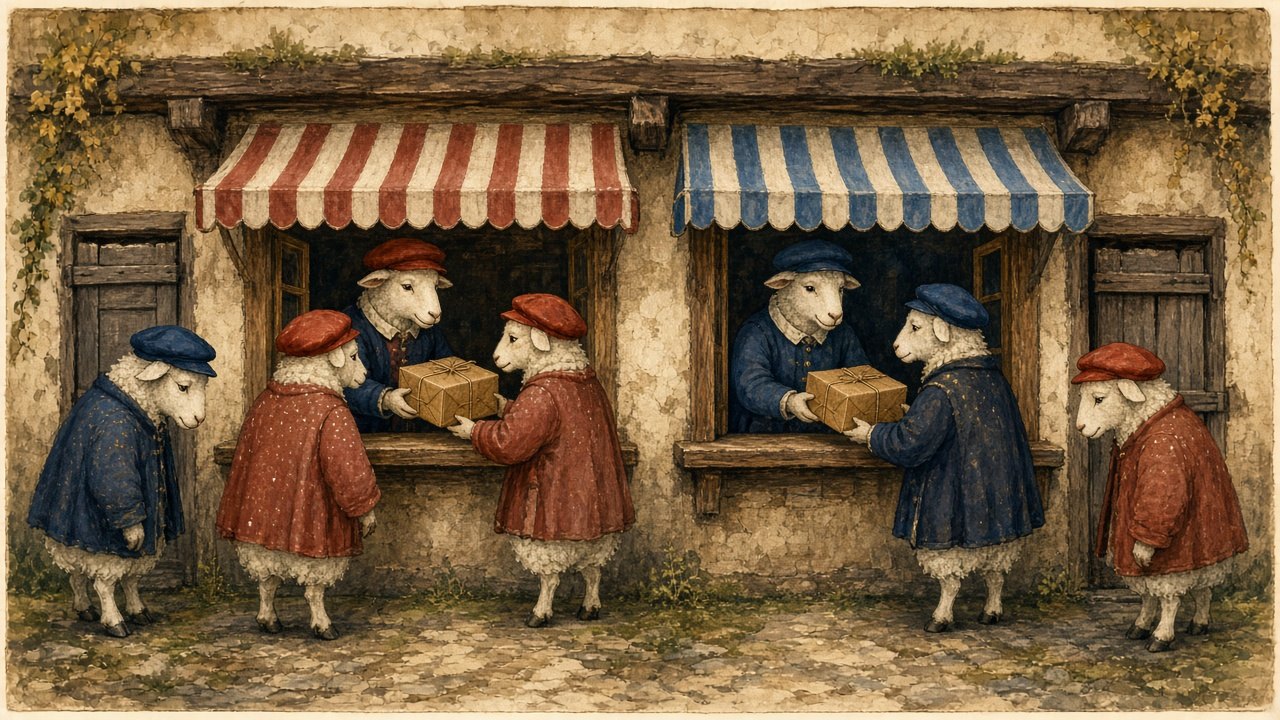
Researchers recruited specimens from both major herds, all of whom agreed with the statement “Tribalism is tearing this country apart.” Each participant was shown a series of short, invented scenarios: a crowd booing a speaker, a group refusing to shake hands, a politician refusing to work with the other party. In half the scenarios the tribalists wore red caps. In the other half, blue.
The results were striking. When the other herd behaved tribally, participants described it as “tribalism,” “dangerous” and “exactly the problem.” When their own herd did the identical thing, participants described it as “standing firm,” “refusing to normalize” and “finally fighting back.” Nearly every participant deplored tribalism. Almost none detected any in their own herd.
“Nearly every participant deplored tribalism. Almost none detected any in their own herd.”
The educated detect it best (in others)
The most sophisticated participants, our team was surprised to learn, were the most accurate detectors of tribalism, as long as it was located at a safe distance.
Specimens who had read several books on polarization could name the psychological mechanisms with precision: motivated reasoning, in-group bias, affective polarization. They applied these concepts fluently, and exclusively, to the other side. One participant, a policy analyst, explained that the other herd “is in the grip of identity-protective cognition,” then explained why his own herd’s positions were simply what the evidence said.
“Knowing the names of the biases doesn’t protect you,” said Dr. Holly Erthanthou, the study’s fictional lead author. “It gives you better vocabulary for diagnosing everyone else. It’s like a doctor who learns every disease and concludes he can’t catch any of them.”
Come together, over here
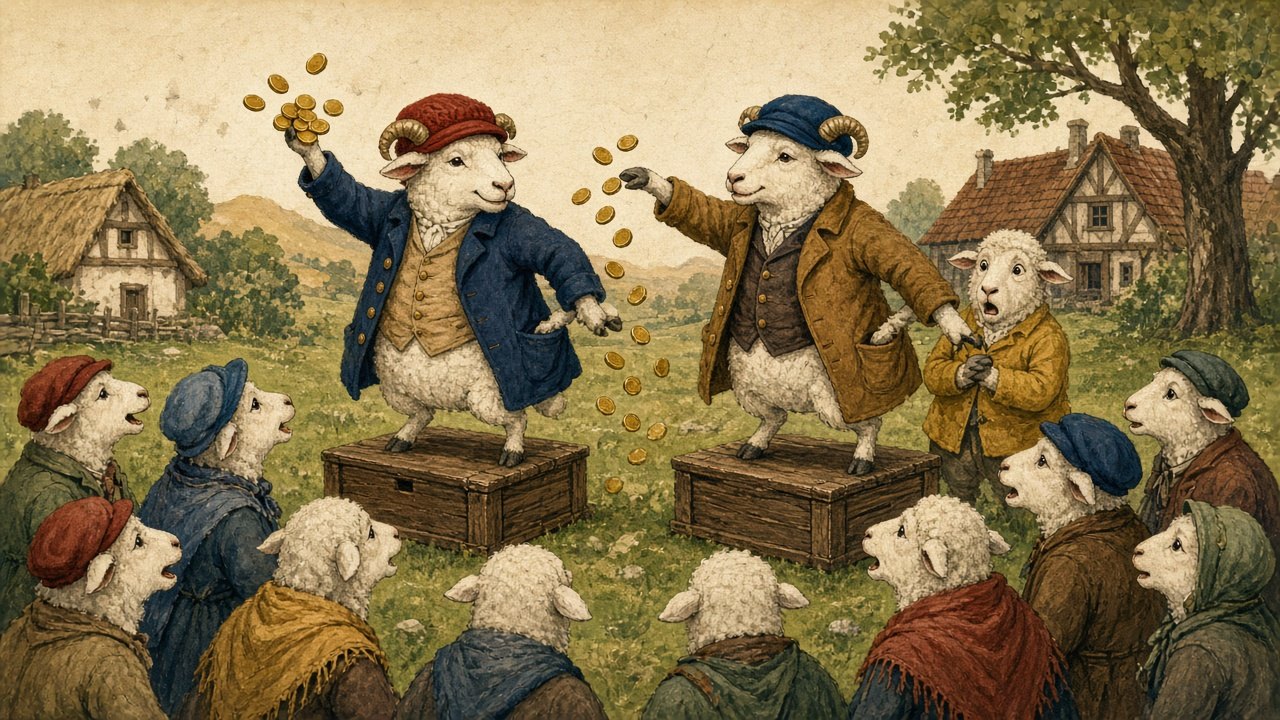
The second phase of the study examined unity speeches from both herds. Every speech we analyzed contained a call for the nation to come together. Every speech, read closely, specified the meeting point. It was always on the speaker’s side of the bridge.
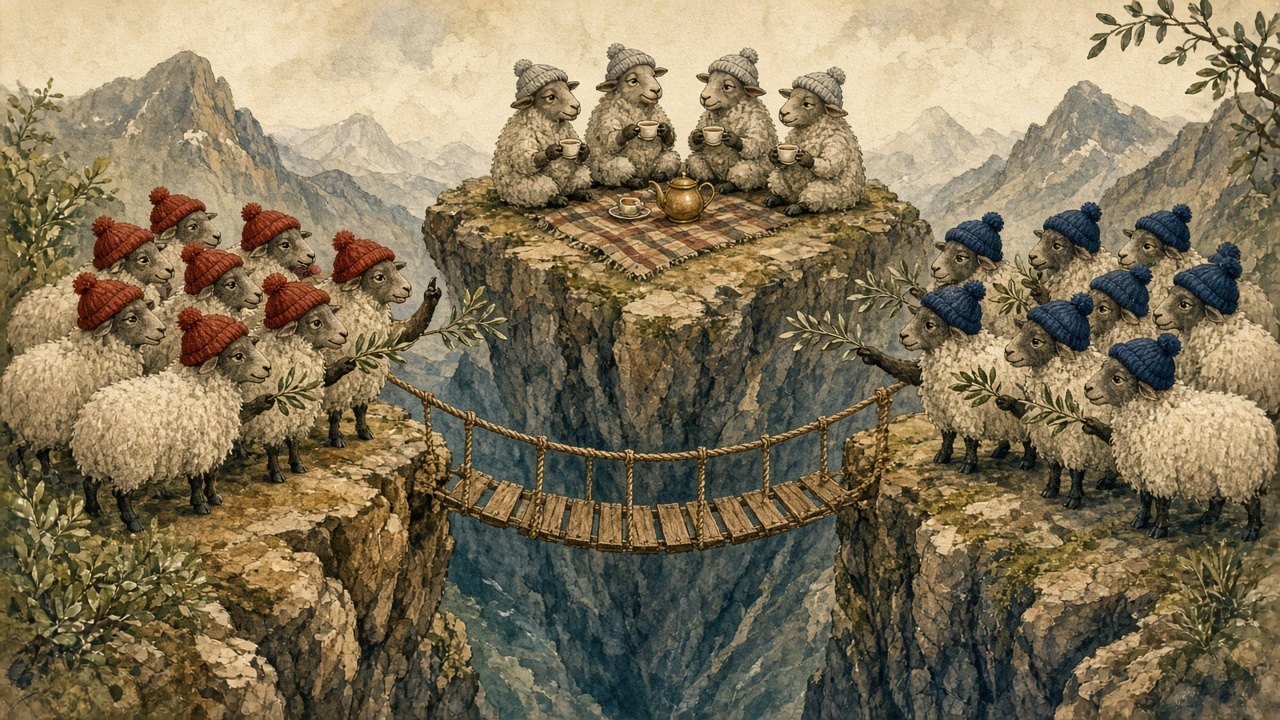
In the Red-Capped version, unity meant the other side would come to its senses. In the Blue-Capped version, unity meant the other side would come to its senses. The olive branch was extended by both herds with great sincerity, on the understanding that the other herd would walk across to accept it.
“Come together” is a lovely phrase. In practice, it is used like a door that only opens one way.
The third herd
Our study’s most important finding came in the final phase, and it concerns you.
There is a third herd. Its members wear grey caps. They are disgusted with both the Red-Capped and the Blue-Capped herds and say so often. They read satire about both. They describe themselves as independent thinkers, above it all. Our researchers named them the Above-It-Alls.
The Above-It-Alls showed the strongest in-group loyalty of any herd in the study. They rated each other as more intelligent, more reasonable and more mature than anyone in either other herd. They were especially quick to identify tribalism in others, because they had two herds to look at instead of one. When shown a scenario in which an Above-It-All sneered at both other herds, they described it as “just being honest.”
It is, our team regrets to report, the herd most likely to be reading this magazine.
Who profits
The person who benefits most from your contempt for the other tribe’s tribalism is whoever sells you the contempt. Each herd’s media rewards it. So does the Above-It-All media, which flatters its audience for being too smart for the other two. Flattery is the perfect hook: nobody fact-checks a compliment.
A small field exercise
At the end of the study, Dr. Erthanthou gave each participant one assignment. Write down one example of tribalism in your own herd from the last month, and one thing the other herd gets right.
Most participants found the first part hard and the second part harder. A few managed both. They reported feeling slightly less certain and slightly less angry, and, to the researchers’ surprise, slightly more hopeful. One of them crossed the bridge. Halfway over, she noticed somebody had started across from the other side.
Satire This article is a work of comedy. Dr. Fieldnote, Hollis Longlens, Dr. Holly Erthanthou, the Institute for Advanced Shrugging, the Above-It-Alls and the Desk of Persuasion are fictional, and the study and its numbers are made up. The illustration is AI-generated and shows no real person. National Sarcastic is not affiliated with National Geographic.