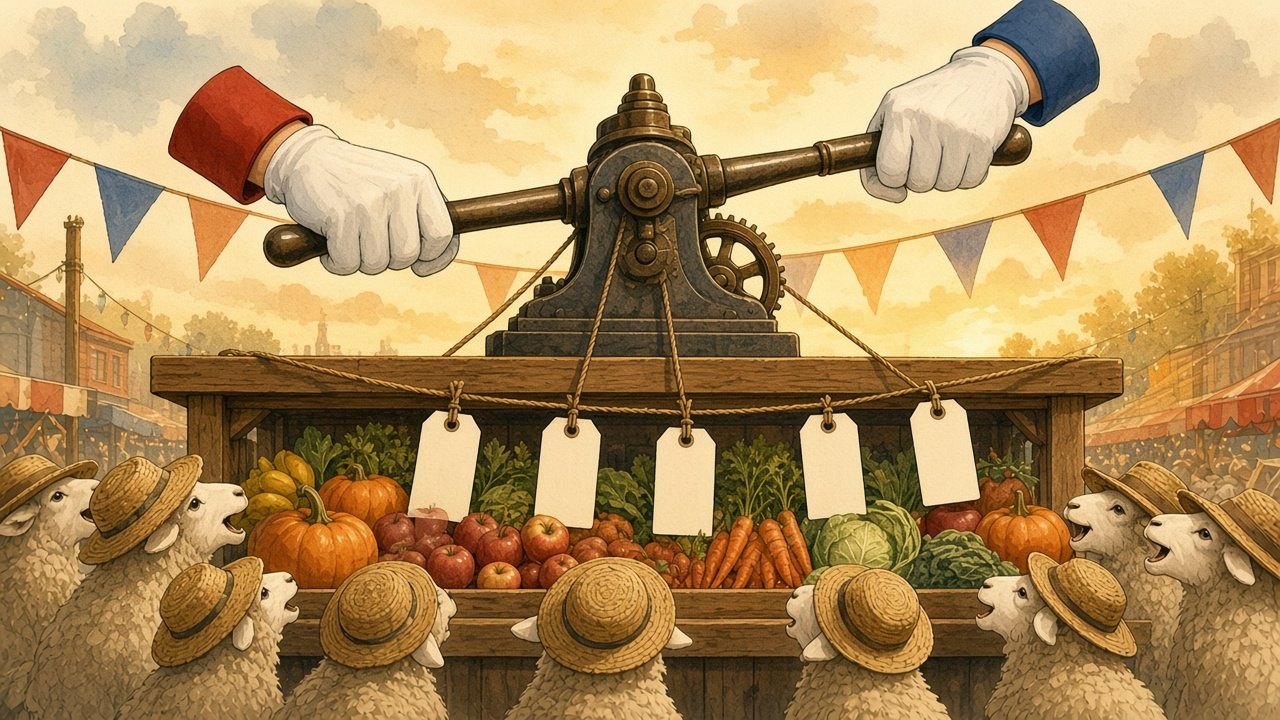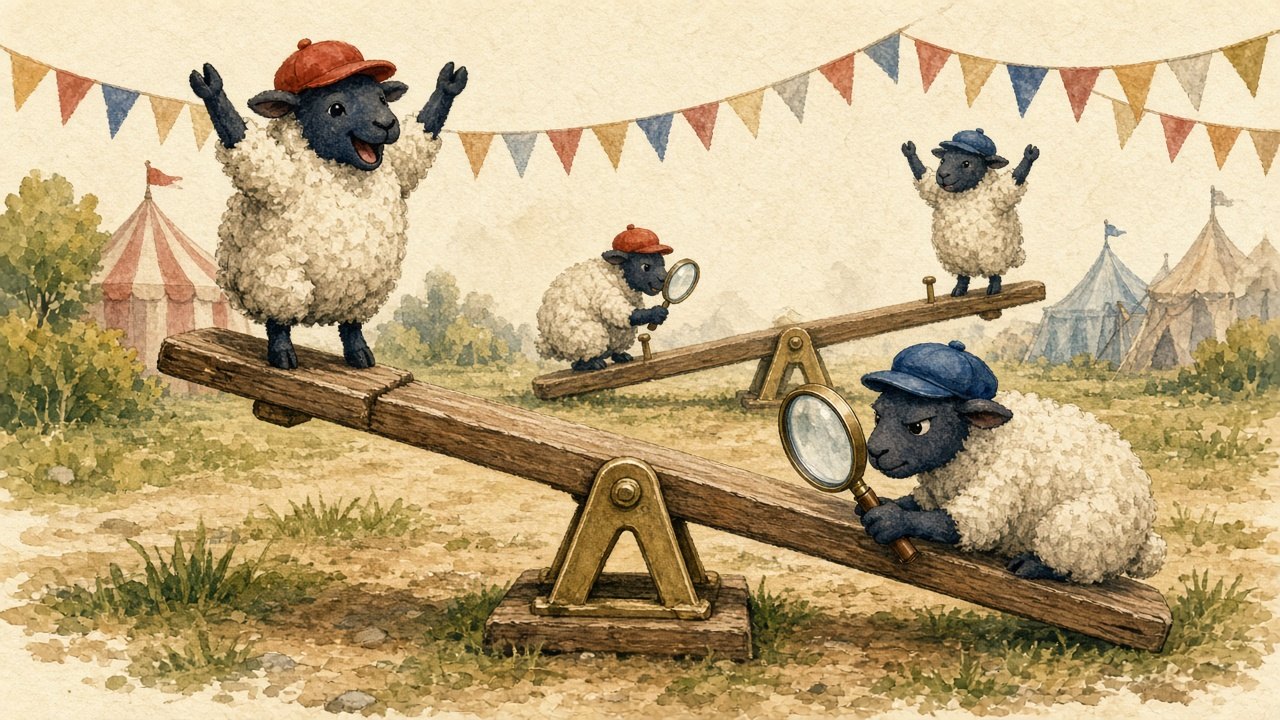
Physicists have long argued about whether an object can be in two states at once. Economists settled the question years ago, and they did it without a laboratory. All they needed was an election.
For eighteen months our team lived on a quiet cul-de-sac with two nearly identical households. Same square footage. Same commute. Same grocery store, same aisle, same carton of eggs. One house flew a small red flag on its mailbox. The other flew a small blue one. We were there to measure the economy. We found two of them.
The smart ones read the data first
The ordinary resident judges the economy by vibes. The sophisticated resident judges it by data, and then by who is president, in that order, but very quickly.
We interviewed analysts, professors and a retired fund manager from both porches. All of them were fluent. All of them had charts. When the other party held office, the charts showed a nation in crisis: prices up, wages “not keeping pace,” a stock market “disconnected from Main Street.” When their own party took office, the same charts showed resilience. Prices were “a lagging indicator.” The stock market was, suddenly and joyfully, Main Street.
“The facts don’t change on Inauguration Day. The adjectives do.”
“It’s not dishonesty,” said Dr. Rosie Outlook of the Center for Directional Economics, which does not exist. “It’s a weighting problem. Every number has a good side and a bad side. A trained mind knows which side to face toward the camera. The trick is that you have to decide which way the camera is facing before you look at the number.”
One receipt, two economies
To test this, we ran what our team called the Receipt Test. We printed a single grocery receipt (eggs, bread, milk, a fictional total of $23.40) and showed it to both households, one month before an election and one month after.
Before the election, the Red-Capped household, whose party was out of power, studied the receipt like a coroner. “Look at that,” said Mr. Anecdote. “Twenty-three dollars. That’s a policy failure.” The Blue-Capped household, whose party was in, waved it off. “One receipt is an anecdote,” said Mrs. Anecdote, no relation, from across the street. “You have to look at the whole picture.”
After the election, power changed hands. We returned with the same receipt, same total, same eggs. Mrs. Anecdote held it up to the light and declared it a policy failure. Mr. Anecdote told us one receipt was an anecdote.
Neither household noticed they had traded lines. When we pointed it out, each household explained why the situation was completely different this time. Both explanations were articulate. Both were about the other guy.
Who profits
Two economies are better business than one. A network that sells the boom and a network that sells the collapse can both report the same jobs number on the same morning, and each keeps its audience. A campaign doesn’t need a plan for prices. It needs your receipt, photographed, with the other party’s logo next to it. A fundraiser doesn’t need the economy to be bad. It needs you to feel that it is, and that it is somebody’s fault.
The cleverest operators don’t argue about the number at all. They argue about who to credit for it. That’s where the money is. The receipt is just the prop.
Who pays
You do, twice. Once at the register, because the eggs cost what they cost no matter who you voted for. And again when you make real decisions (whether to buy the house, whether to take the job, whether to start the business) based on an economy that only exists on your porch. Our team watched one household delay a perfectly sensible purchase for two years because “everything is collapsing,” while the household across the street made a reckless one because “everything is booming.” They were looking at the same street.
The economist in the mirror
Here is a small exercise. Think back to the last time power changed hands. Did your opinion of the economy change that week? Did your grocery bill?
We are not telling you whether the economy is good. Honestly, we don’t know, and anyone who answers in one word is selling something. The answer depends on which prices, which jobs, which region and which year. That’s exactly why it can’t depend on which party.
The test is simple. If an argument about the economy only works when you know who’s in charge, it isn’t an argument about the economy.
The household that kept a ledger
On our last evening we met a third household at the end of the cul-de-sac. No flag on the mailbox. The owner, a retired bookkeeper, kept a paper ledger on the kitchen table: every grocery receipt, every month, for eleven years, in pencil.
We asked her whether the economy was booming or collapsing.
She turned the ledger toward us. “Eggs went up. Gas went down. My pension went up a little. The roof is due.” She shrugged. “Which part do you want?”
Neither network has booked her. Her answer takes too long, and it doesn’t have a villain.
Satire This article is a work of comedy. Dr. Fieldnote, Hollis Longlens, Dr. Rosie Outlook, the Center for Directional Economics, Mr. and Mrs. Anecdote and the Desk of Persuasion are fictional, and the field counts are made up. No real economic figure is cited. The illustration is AI-generated and shows no real person. National Sarcastic is not affiliated with National Geographic.