Most species adapt to their environment. Two species we observed on the fictional Soggybottom Coast have done something more advanced. They have adapted their environment into an outfit.
We spent a season on that coast, which hosts two great gatherings a year. In the dry season, a flock of climate delegates lands at a beach resort to discuss sacrifice. In the wet season, a caucus of drill-baby-drill legislators leaves its beach homes to avoid a storm. Our team was there for both. We brought binoculars, rain gear and, on the advice of the resort, a dinner jacket.
The smart ones sacrifice first, on your behalf
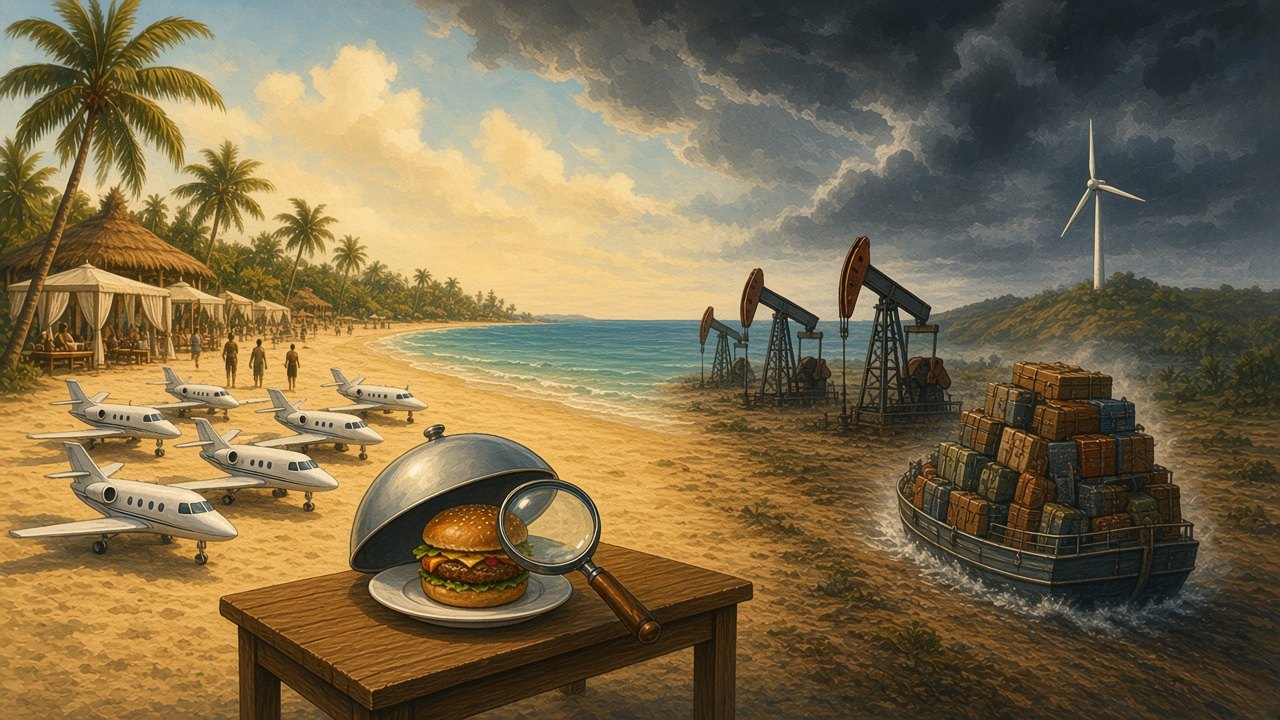
We began, as we always do, with the sophisticated. The summit flock is made up of the most educated birds on the coast: scientists, consultants, executives and the writers who cover them. We counted 212 private jets on the resort’s temporary airstrip, a fictional figure we stand behind completely.
The delegates were not embarrassed. They were prepared. “My flight is offset,” one consultant told us, “by a forest that will be planted, eventually, somewhere with a lot of room.” Another explained that his attendance was “net positive,” because the decisions made at the summit would save far more carbon than his jet burned. We asked which decisions. He said that was what the summit was for.
“The rules are for people. The delegates are here to make the rules.”
The keynote session was titled “The Hamburger Question.” It concerned your hamburger, specifically. Lunch was wagyu. “It’s not hypocrisy,” said Dr. Carb N. Offset of the Institute for Carbon Theatre, which does not exist. “It’s division of labor. Some people make sacrifices. Other people explain sacrifices. Both are essential. Only one of them needs a jet.”
The other flock evacuates, on schedule
Four months later we returned for the wet season. The second flock, the Drill-Baby-Drill Caucus, owns much of the coast’s oceanfront. Its members are no less sophisticated. Our team recorded a geologist, a former insurance executive and a councilman with an economics degree, all of whom explained, fluently, that the climate has always changed, that models have error bars, and that anyone who worries about it is being manipulated.
Then the third storm of the season came in, and they evacuated. Efficiently. They had a plan, a generator and, in at least two cases, a second home inland. We observed one member file a flood claim with a government-backed program while describing government as the problem. The councilman, from a hotel lobby, blamed the wind turbines on the hill. We asked how. He said that was what the hearings were for.
Two costumes, one closet
The costume works the same way for both flocks. One tribe wears concern. Its sacrifices are real, but they are for other people: your burger, your car, your thermostat, your flight to see your mother. The other tribe wears defiance. Its denial is also real, and it is also for other people: the coastlines, the flood maps and the insurance pools that someone else will pay into.
Neither flock is talking about the planet. Each is talking about the other flock, in a voice designed to be heard back home. And each flock has quietly agreed to skip the same question: what is this actually costing, who is paying, and what would we do differently if we meant it?
Who profits
A summit is an industry. It needs venues, consultants, panels, credentials and next year’s summit. A hurricane is an industry too. It needs alarm, ratings, fundraising emails and a villain, ideally one standing on a hill and turning slowly. Both flocks raise money from the same fact: the other flock exists. Neither one would survive the other’s disappearance.
The costume in the mirror
You probably spent this article laughing at one of these flocks and nodding at the other. That is the costume working on you.
Try this. Name one thing your own tribe asks of other people about the environment. Now name one thing you have actually done yourself, at a cost you noticed. If the first list is long and the second is short, you are wearing the outfit.
We are not telling you what the climate will do. That’s a question for evidence, measured carefully, and argued in the open. It is not a question for flocks.
The fisherman
On our last morning, after the storm, we met a fisherman named Hal Ibut (fictional) re-tying his boat in Port Soggybottom. He had moved it inland two days early, because he reads the tide tables and the barometer himself. He had also replaced his engine with a more efficient one, because fuel is expensive.
We asked whether he was an environmentalist or a skeptic. He looked confused. “I’m a guy with a boat,” he said. “The water doesn’t care who I voted for.”
Neither flock invited him to speak. He didn’t have a costume.
Satire This article is a work of comedy. Dr. Fieldnote, Hollis Longlens, Dr. Carb N. Offset, the Institute for Carbon Theatre, the Soggybottom Summit, Port Soggybottom, its storms, its councilman and the Desk of Persuasion are fictional, and the field counts are made up. No real climate finding, storm or event is cited. The illustration is AI-generated and shows no real person. National Sarcastic is not affiliated with National Geographic.