The American adult male has long been regarded as one of the most studied creatures on the continent, and one of the least consulted. This season our team set out to observe the two great research traditions that have claimed him, expecting to find bitter rivals. We found something more remarkable: a scientific consensus.
Two traditions, one specimen
On one side of the field stands Dr. Patty Archy, a lecturer who teaches a popular seminar called “Men: A Remedial Course.” Dr. Archy is fictional, articulate and genuinely well read. On the other side stands Rex Grindset, host of a podcast called “The Unsupervised Male Hour.” Rex is also fictional, also articulate, and, it must be said, also genuinely well read, mostly in the evenings, mostly about Roman generals.
The two would not willingly share a stage. Dr. Archy describes Rex’s audience as “lost.” Rex describes Dr. Archy’s students as “lost.” This was our first clue.
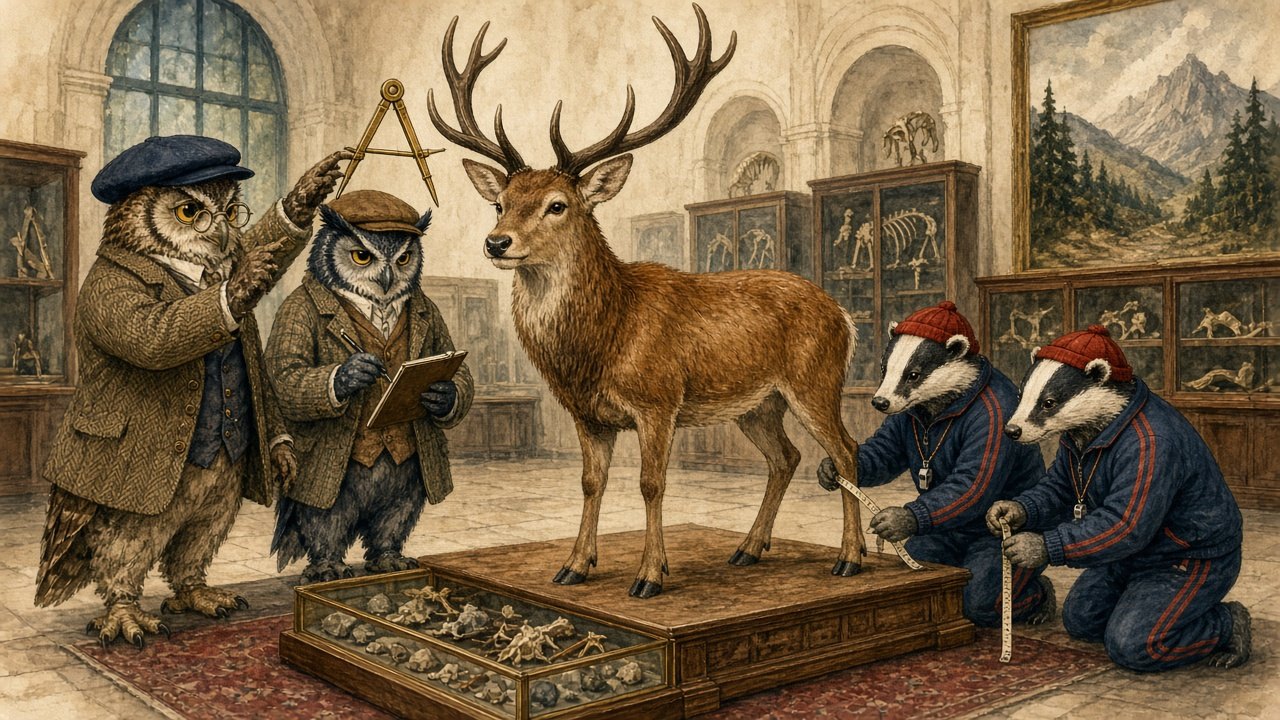
We presented each of them, separately, with the same specimen: a 36-year-old logistics coordinator named Norm Allguy, who likes woodworking, calls his mother on Sundays, and once cried at a movie about a dog.
The diagnosis
Both experts examined Norm. Both took under ten minutes. Both arrived at the same conclusion: Norm is a simple machine, running on a few primitive drives, who cannot be trusted to operate himself.
Dr. Archy’s assessment was that Norm had been “conditioned by a script he can’t see,” and that without guided reflection he would default to behaviors he did not choose. Rex’s assessment was that Norm had been “domesticated by a culture that wants him weak,” and that without a strict program he would default to behaviors he did not choose.
“Both took under ten minutes. Both concluded Norm was a simple machine who could not be trusted to operate himself.”
The vocabulary differed. The structure was identical. Norm is broken, Norm does not know he is broken, and Norm’s repair requires a qualified technician, who happened in both cases to be the person speaking.
“The diagnosis comes first,” explained an anonymous admissions consultant who has worked with programs of both kinds. “The man comes second. Honestly, the man is optional.”
The ordained expert
What made both experts persuasive was not that they were foolish. It was that they were clever. Each could cite studies. Each had a vocabulary that turned disagreement into a symptom. If Norm objected to Dr. Archy, that was defensiveness, which proved the conditioning. If Norm objected to Rex, that was weakness, which proved the domestication. Neither system contained a slot for the possibility that Norm had simply considered the matter and disagreed.
This is the signature of an ordained expert. The credential is not a method. It is a membership card, and the theory is built so that every objection becomes more evidence.
Follow the money
We asked the obvious question: what happens if Norm is fine?
The answer, for both traditions, was alarming. A seminar about a problem needs the problem. So does a subscription. Dr. Archy’s course fills a requirement, attracts grants and sells a book. Rex’s program offers a tiered membership, a supplement partnership and a weekend retreat. A Norm who is basically fine, and capable of working out his own life with his own friends, is a Norm who does not enroll and does not renew.
We are not suggesting either expert is insincere. Sincerity is what makes it work. The most effective salesperson is the one who has bought the product.
Norm in the mirror
The reader, at this point, has likely chosen a side. One camp is enjoying the jab at the podcast. The other camp is enjoying the jab at the seminar. Both camps should notice they were enjoying it at the same time, at the same speed, for the same reason. Your expert is the one who tells you what is wrong with the men you don’t know, and is gentle about the ones you do.
There are real questions about how men are doing, and serious people study them carefully on every side. Careful work tends to begin by asking the subject a question and writing down the answer, even when the answer is inconvenient. Neither of our experts did that.
What the specimen said
On the last day, after both experts had left, our team did something unusual in the literature. We asked Norm what he thought.
He thought for a while. He said some of what each had told him was true, and some of it was nonsense, and that he would rather work it out with his brother and his oldest friend, who were cheaper. Then he went back to sanding a chair.
We noted the behavior carefully. It does not fit either model. It may be the most important finding of the season: the specimen was not simple. He had only been described by people who needed him to be.
Satire This article is a work of comedy. Norm, Dr. Fieldnote, Hollis Longlens, Dr. Patty Archy, the seminar “Men: A Remedial Course,” Rex Grindset, the podcast “The Unsupervised Male Hour” and the Desk of Persuasion are fictional. No real course, scholar, show or host is described. The illustration is AI-generated and shows no real person. National Sarcastic is not affiliated with National Geographic.