For eleven seasons our team has tracked the American voter across its range, documenting feeding, nesting, and the elaborate threat displays performed in grocery-store parking lots. In all that time we had never once recorded the behavior that biologists call a change of mind, and that voters call betrayal.
Then, on a damp Tuesday in a swing-county library, we found Moe Derate.
A sighting, confirmed
Moe (not his real name, which he asked us to withhold because he still hopes to be invited to things) sells irrigation pumps for a living. For most of his adult life he held a firm position on one policy question. We will not tell you which question, or which way he leaned. Both herds would know instantly which side to be angry at, and would be angry before finishing the sentence.
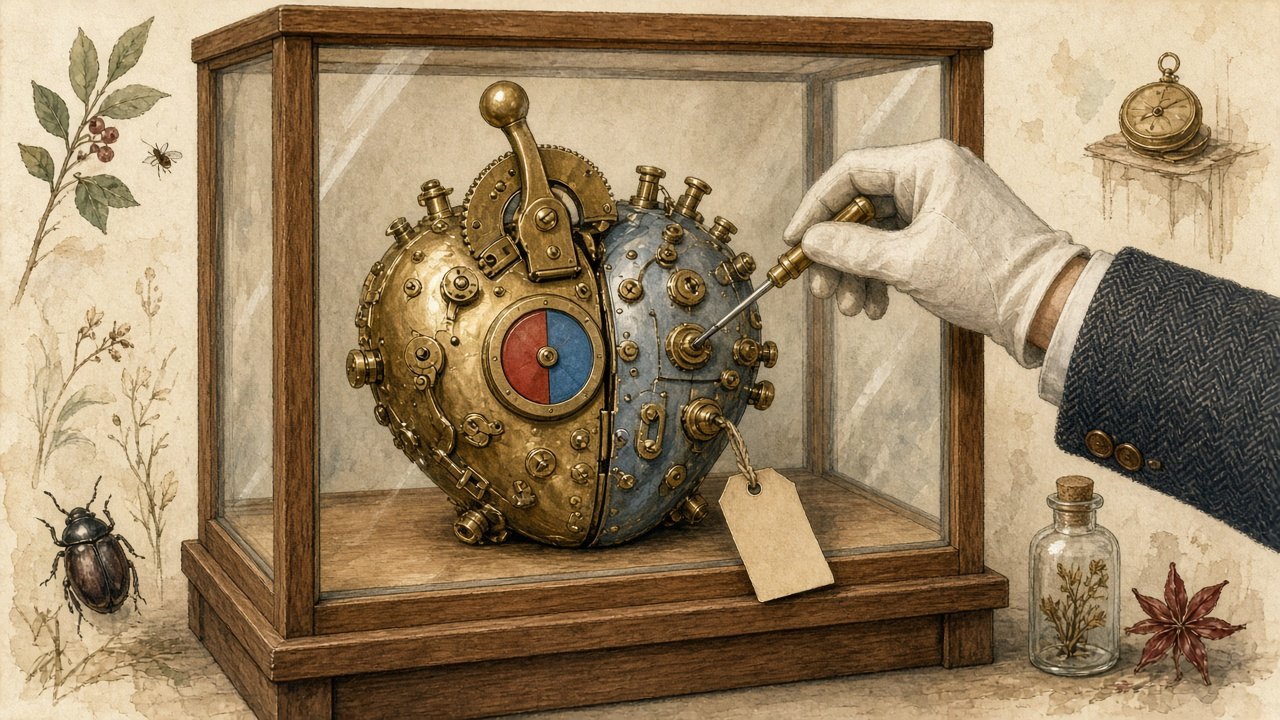
Here is what happened. Moe read a long article that disagreed with him. Then, and our field notes underline this twice, he read a second one. He looked up a number. He called his brother-in-law, who works in the field in question, and asked a question he did not already know the answer to. Over about three weeks, Moe arrived at a different view.
“The literature describes this as possible,” said Dr. Herb Mentality, a behavioral ecologist at the Institute for Advanced Shrugging, which does not exist. “The way the giant squid was described as possible. You hear stories. Somebody’s uncle. You don’t expect to see one in a library holding a highlighter.”
The smart ones arrive first
The first predators to reach Moe were not the loud ones. They were the educated ones.
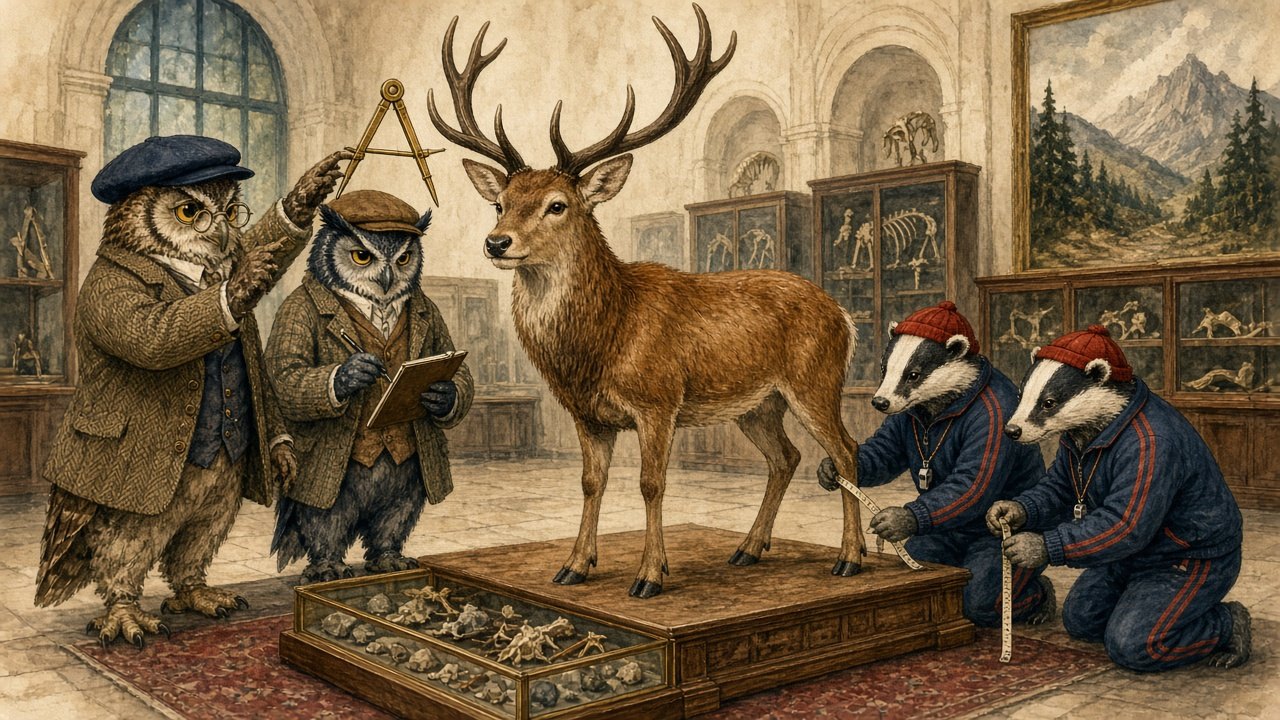
Within a day of his first cautious post, three credentialed acquaintances had weighed in: a tenured professor, an attorney, and a man with a podcast about leadership. None of them addressed the evidence Moe had read. They addressed Moe.
The professor explained, with footnotes, that Moe’s new view was understandable but “naive about the incentive structure.” The attorney noted that people who change positions “often have reasons they aren’t disclosing.” The podcaster said he had once considered changing his mind too, and found that the feeling passed if he went for a run.
“None of them addressed the evidence Moe had read. They addressed Moe.”
A less polished herd member simply calls a defector a traitor. The educated one builds the traitor a motive. It takes longer, cites more sources, and arrives at the same place. Intelligence does not protect the specimen from tribal reasoning. It just gets him a better lawyer.
Expelled by both herds
What astonished our team was the symmetry.
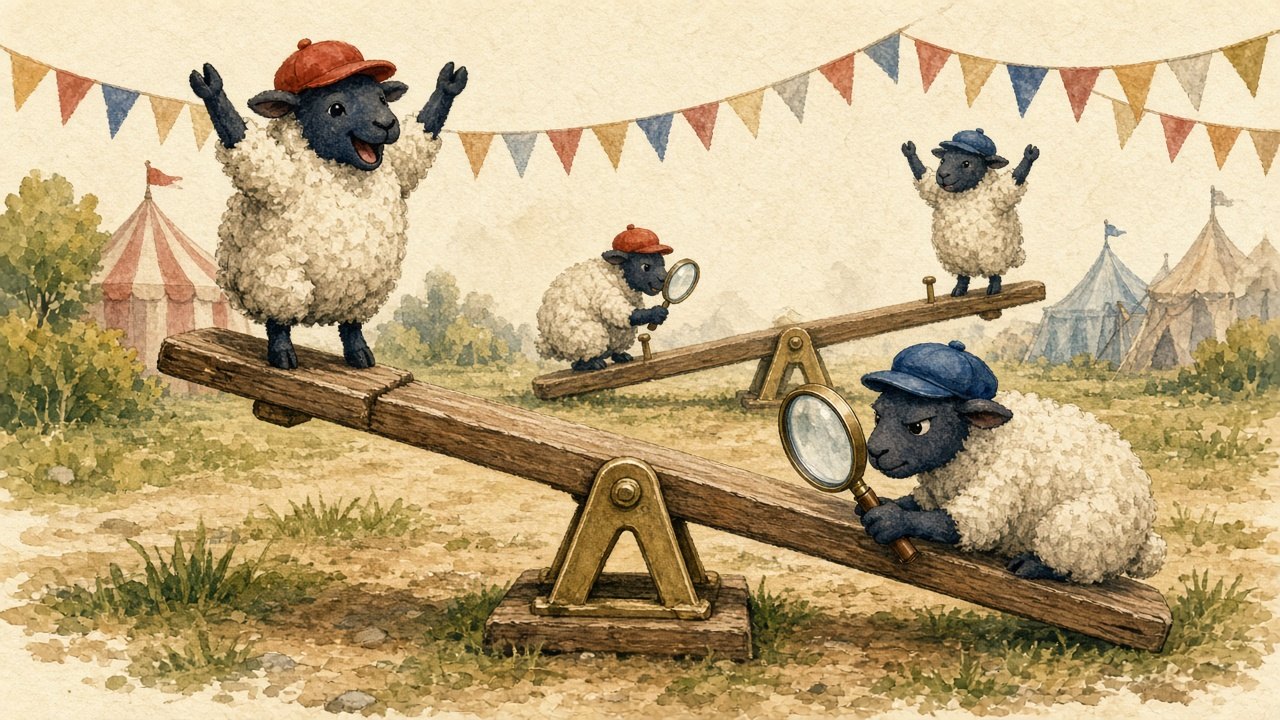
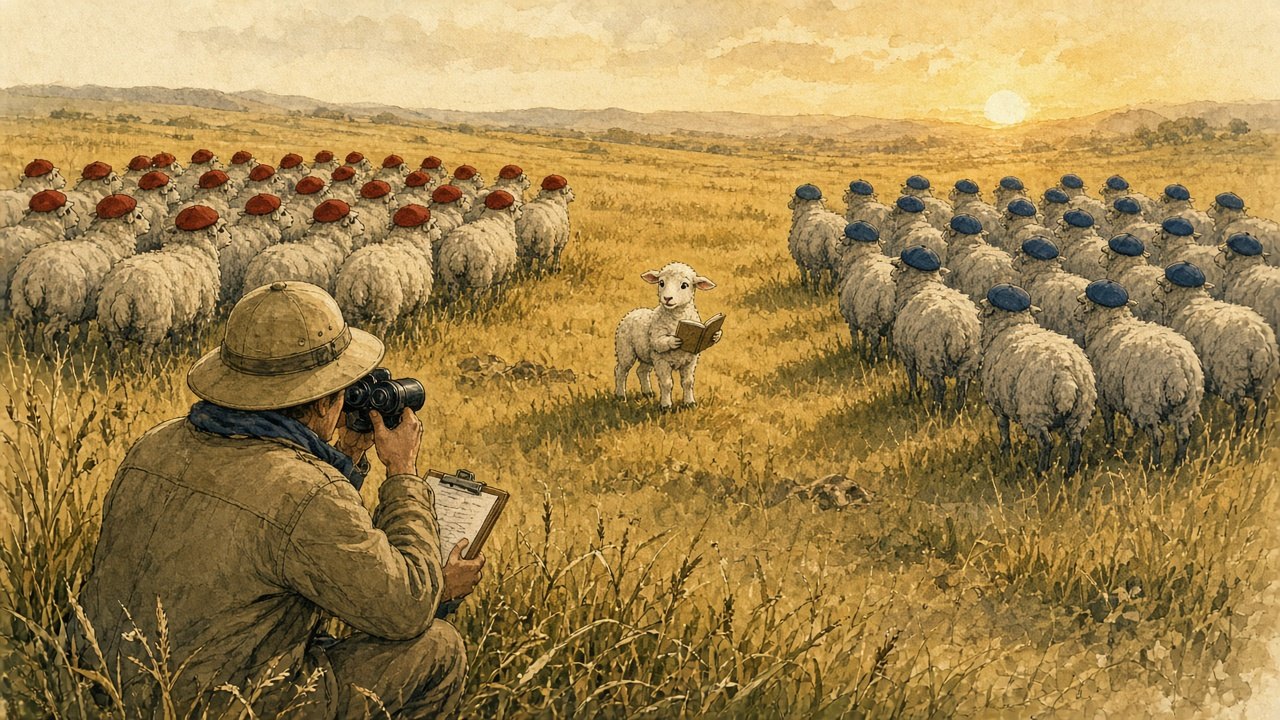
Moe’s old herd concluded he had gone soft. He had “let them get to him,” the “them” never specified. The herd he drifted toward was no warmer: to them he was a grifter angling for an audience. A second specimen in a neighboring county drifted the opposite way, and the labels simply swapped hands. Red-Capped or Blue-Capped, the deserter had always “gone soft” or “sold out,” and the new herd’s welcome lasted exactly until he disagreed with it about something else.
The herd he left could not forgive the departure. The herd he approached could not trust a creature that had proven it could move. A voter who changed his mind once might do it again, and that makes him useless as livestock.
Who profits from a herd that never moves
We followed the money, as one does.
A herd that never changes its mind is enormously valuable. It can be counted on. It can be mailed to. Its outrage can be scheduled like a dental cleaning. The professional class that feeds on each herd, the fundraisers, the segment producers, the people who write email subject lines in all capitals, depends on one assumption: that the herd’s position next year will be its position this year, only angrier.
Moe threatens that assumption. He is proof of concept. If one specimen can read two articles and move, others could. Then every herd would have to persuade its members instead of herding them, and persuading is expensive.
So the expulsion is not really about Moe. It is a demonstration for everyone watching: you may think anything you like, as long as it’s what you thought last time.
The specimen in the mirror
Here we must turn the binoculars around.
Readers of this magazine, being smart, have presumably been picturing the other herd doing the expelling. We have field notes on you as well. Think of the last time someone on your side changed position. Did you examine their reasoning, or their motives? Now think of someone who crossed over to your side. Was that courage? Funny how courage always seems to travel in your direction.
We are not saying Moe is right. We don’t know whether his new view is correct. Neither, we noticed, did anyone who expelled him, because no one asked.
At dusk
On our last evening in the field, we found Moe Derate on a bench outside the library, reading. He had lost a few dozen followers, two cousins and one wave from a neighbor.
“I don’t really belong anywhere now,” he told us. He shrugged and turned the page. “But I know more stuff.”
We watched until the light was gone. A mind moving under its own power is a rare thing to see in the wild. We have asked for the species to be protected. We are not optimistic. But the specimen looked healthy, and as long as one remains, the species is not technically extinct.
Satire This article is a work of comedy. Moe, Dr. Fieldnote, Hollis Longlens, Dr. Mentality, the Institute for Advanced Shrugging and the Desk of Persuasion are fictional, and the field data is made up. The illustration is AI-generated and shows no real person. National Sarcastic is not affiliated with National Geographic.