In a rare show of unity, leading moral philosophers from both major political tribes have issued a joint statement settling one of the oldest questions in ethics. The ends, they confirm, do justify the means. There is one condition, which both signatories describe as “minor”: the ends must be ours.
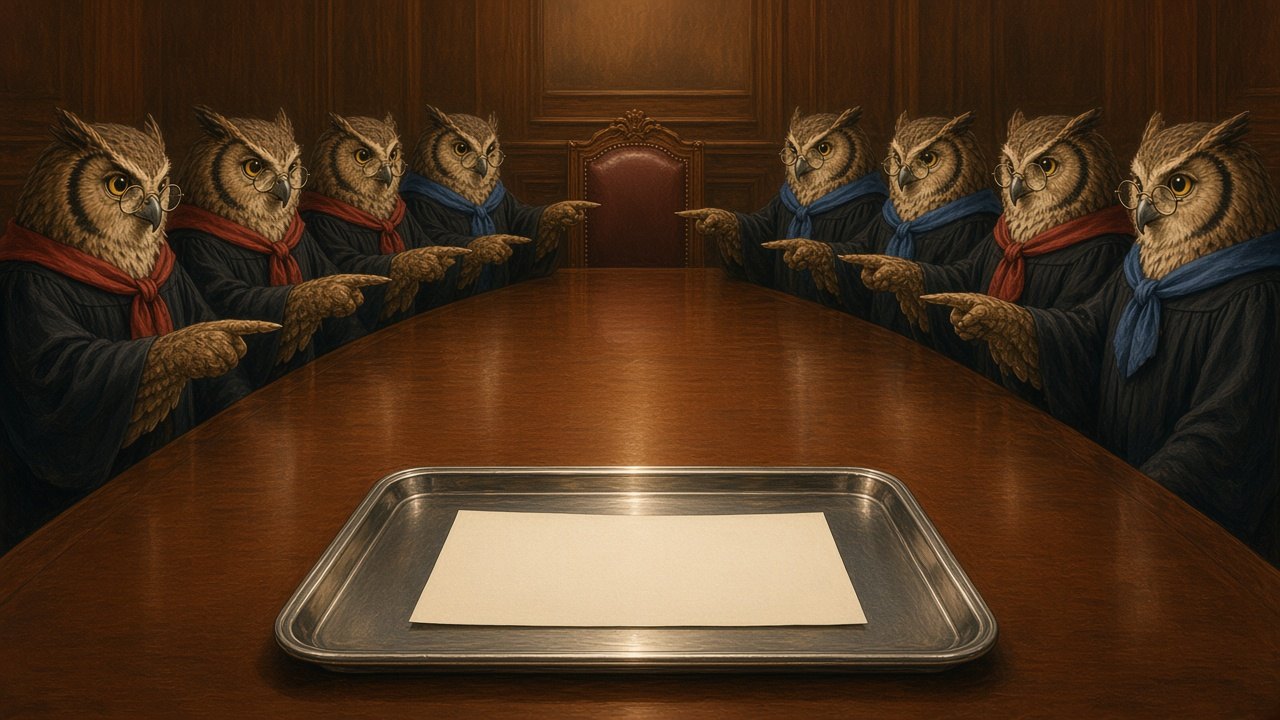
The statement was produced by the Joint Panel on Flexible Ethics, a fictional body made up of Professor Justin Ends, a Red-Capped ethicist, and Professor Ann Y. Means, a Blue-Capped ethicist. They have disagreed about almost everything for thirty years. They agreed about this in under an hour.
The statement
The Panel’s statement is a single sentence: “When the stakes are this high, the normal rules cannot be allowed to stop us from doing what is necessary.”
Here at the Spoof desk, we take one image and crop it two ways. This time we did it with a sentence.
Read by the Red-Capped herd, “the stakes” are the nation’s survival, “the normal rules” are the procedural niceties the other side hides behind, and “what is necessary” is whatever the herd’s leaders are currently doing. Read by the Blue-Capped herd, “the stakes” are the nation’s survival, “the normal rules” are the procedural niceties the other side hides behind, and “what is necessary” is whatever the herd’s leaders are currently doing.
“They have disagreed about almost everything for thirty years. They agreed about this in under an hour.”
The words are identical. The crop is identical. Both herds believe the sentence was written for them.
Saving and destroying democracy
The Panel’s footnote, which neither member signed, describes how the principle is applied in practice.
When a herd’s own leaders change a rule mid-game, draw the map with a very particular pencil, block an appointment, rush an appointment, or find a creative new reading of an old procedure, the herd describes this as “saving democracy.” When the other herd’s leaders do any of the same things, the herd describes it as “destroying democracy.” The actions are the same. The vocabulary is what changes, and it changes on the same afternoon.
We are not describing any particular rule or any particular year, because there is no need to. Both herds can supply their own examples, and both herds, in our experience, can supply them only for the other side.
The smart ones write the justification
Professor Ends and Professor Means are not fools. They are, in fact, the reason this works.
An ordinary partisan who wants to break a norm simply breaks it. A trained ethicist explains why the norm never applied. Professor Ends, writing for his herd, can produce four thousand words on the doctrine of necessity. Professor Means, writing for hers, can produce four thousand words on the ethics of emergency. Both essays cite the same philosophers. Both conclude that this time is different, and that history will understand.
“The norm is for the other team,” said an anonymous staffer who has drafted talking points for both kinds of ethicist. “Our side doesn’t have norms. It has principles. Principles are flexible. Norms are for losers, which is why we write them down.”
The crusade flag
Each herd’s hardball is marched under a flag. One flies freedom. The other flies justice. Both fly democracy. The flag is important, because once the cause is sacred, disagreeing with the method becomes disagreeing with the cause. Ask about the rule change and you will be asked, sharply, whether you are in favor of losing everything.
And each herd has a favorite way to end the argument without having it. Question the method, and you are told you are “naive about what’s at stake.” Or you are asked “whose side are you on?” Both questions are designed to end the discussion before anyone looks at the method.
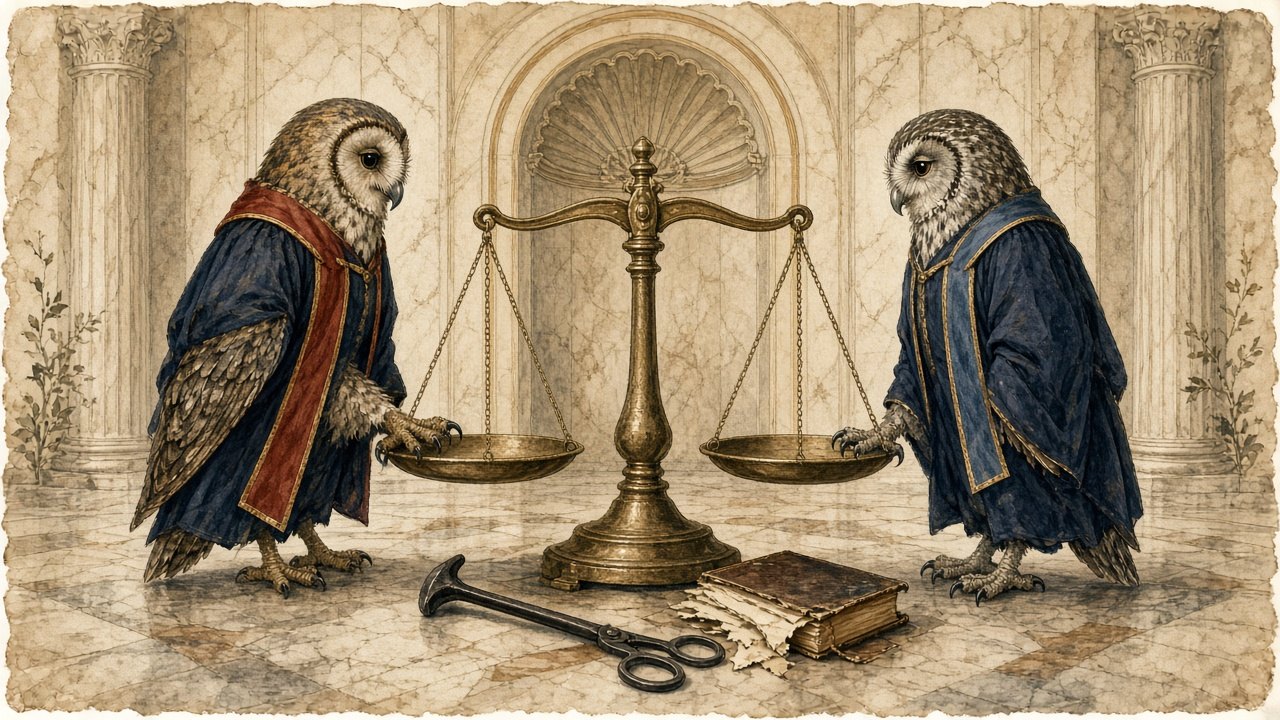
The scale in the mirror
The reader may now try the Panel’s principle on his own herd. Take the last procedural move your side made that you cheered. Now imagine the other side had done exactly the same thing, the same rule, the same timing, the same justification. Would you have called it saving democracy?
There is a reason norms exist, and it is not to protect the other team. It is to protect you, on the day the other team holds the pen. Every tool your side builds for an emergency will eventually be inherited by the people you were afraid of.
The dissent
There was, it emerged, a third member of the Panel. She was not invited to the signing. Her dissent, submitted on paper, is two sentences long.
“I agree that the stakes are high. That is exactly why I want rules I would accept in the other side’s hands.”
Professors Ends and Means agreed it was naive. They agreed so quickly that they both looked briefly troubled, and then went to lunch together, for the first time in thirty years.
Satire This article is a work of comedy. Theodore Quagmire, Inés Telefoto, the Joint Panel on Flexible Ethics, Professor Justin Ends, Professor Ann Y. Means and the Desk of Persuasion are fictional, and so is their statement. Procedural hardball is described generically; no real rule change, case, official or event is described. The illustration is AI-generated and shows no real person. National Sarcastic is not affiliated with National Geographic.