About This Guide
Congratulations. You are holding this guide, which means you are one of the smart ones. We know because everyone who opens this guide is one of the smart ones. It says so right here, you believe it, and that is how we know.
Here is the problem. Thinking for yourself is exhausting, lonely, and likely to end with you agreeing with someone you can’t stand. Worse, it sometimes works, and then you have to change your mind in front of people. Nobody needs that.
Fortunately there is a better way, and roughly half the country has already mastered it. The other half has mastered it too. They just think they’re the half that hasn’t.
This guide teaches you to parrot your tribe while experiencing every thought as a bold, private act of courage. It works whether your tribe is red, blue, or the kind of person who says “I’m not political” in a tone that is extremely political. You will not need to read anything you disagree with. You will not need to read much at all.
Chapter 1Pick Your Conclusion First
Amateurs start with a question. Professionals start with the answer and work backward until they find a question that leads there.
Choose your conclusion the way you’d choose a sports team: by geography, family, and which side your loudest uncle yells for. Once chosen, it is no longer a conclusion. It is a part of you. Changing it now would be like changing your blood type because someone showed you a chart.
Chapter 2Research Is Just Finding Agreement
Look at the word. Re-search. You search again, and again, until you find someone who agrees with you. Then you stop, because the research is complete.
- Type your conclusion into a search bar, followed by the word “proof.”
- Click the first result that confirms it. Read the headline. Headlines are where the facts are kept.
- If a result disagrees, check who published it. If it’s the other side, it’s biased. If it’s your side, it’s been infiltrated.
- Share it with the caption “Interesting.” Everyone will know what you mean.
Smart people do exactly the same thing, with footnotes. Nothing is more persuasive than a 40-page report you didn’t read, from an institute whose name sounds like a cough drop, confirming what you believed in sixth grade. Citing it shows you respect evidence. Not reading it shows you respect your time.
Chapter 3How to Call Your Tribe’s Talking Points “Independent Research”
This is the central technique of the guide. Take the exact sentence your side said this morning and repeat it as if you’d arrived at it alone, after weeks in a cabin with a lantern and a legal pad.
Open with one of these independence markers:
- “I’m just asking questions.” You are not. Questions end in question marks, and you would be furious at an answer.
- “I’ve looked into it.” You watched a clip. Part of a clip.
- “As someone who thinks for himself…” Proceed to say the sentence several million people said today, in the same order, with the same pause.
- “I’m not on either side, but…” You are on a side. It’s the one after “but.”
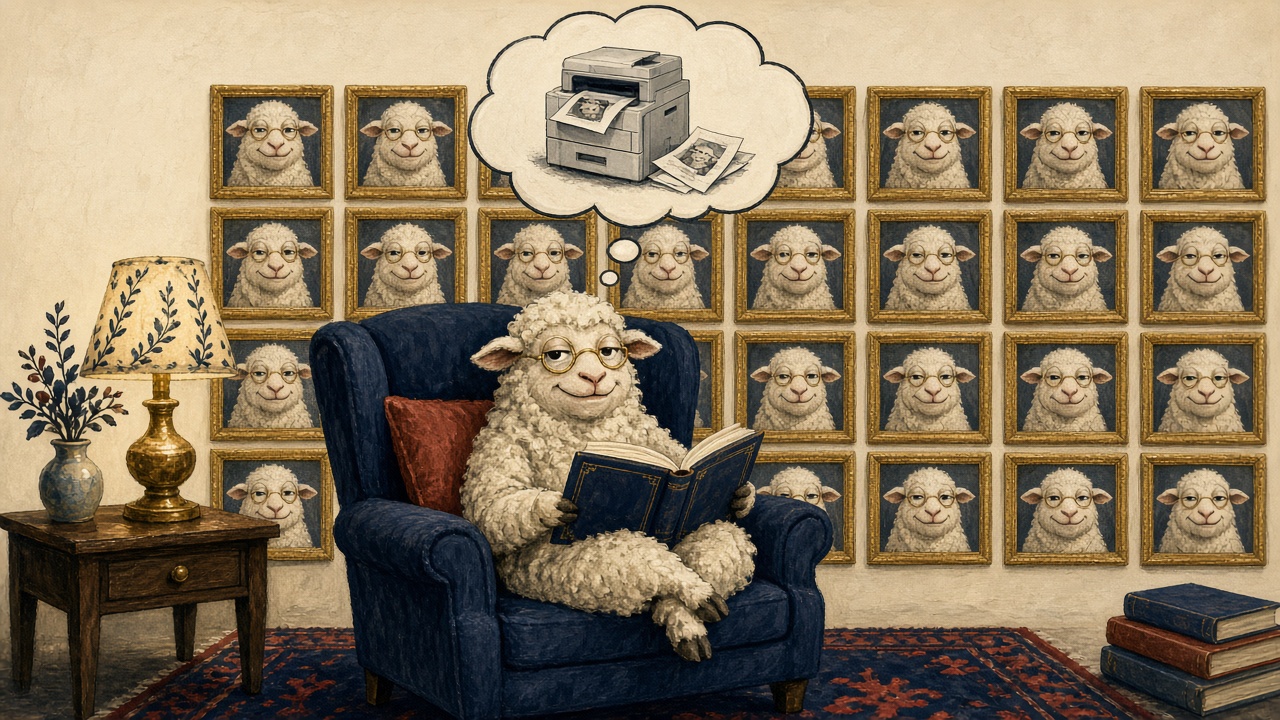
The old masters of manipulation worked out long ago that you don’t need to control what a person does. You only need to break his trust in his own judgment. Then he hands you the leash and calls it a fashion choice. The method is simple: replace “What do I think?” with “What do people like me think?” That second question is a poll. Let him take the poll every morning and believe the result is his own idea. That’s what you’re doing now. Congratulations on becoming a poll.
Chapter 4Spotting Sheep (Hint: They Disagree With You)
Sheep are easy to spot. They believe whatever their side tells them, they repeat talking points, and they can’t think for themselves. You can tell because they disagree with you, and you think for yourself. So does everyone you agree with. It is a remarkable coincidence that every independent thinker in the country ended up in the same group chat, but greatness clusters.
Chapter 5The Smart-Person Upgrade
If you are smart, and the receipt says you are, you have a special advantage: you rationalize faster. Ordinary tribal thinkers repeat the talking point word for word. You paraphrase. You add a hedge, a historical analogy, and the word “nuanced.” You arrive at exactly the same place in three times the words, which makes it look like a journey.
The smarter you are, the better your defense lawyer. Hand your brain any conclusion and it will build a beautiful courtroom case for it, then congratulate you on being so fair. That isn’t a bug. That’s what the education was for.
And here is the lever every persuader in the business pulls first: the belief that you’re one of the smart ones. “Smart people like you already know…” is the most effective half-sentence in politics. It works in both directions, because both directions are full of people who are certain they’re the smart people.
Chapter 6Mock Both Parties (Fairly, Like a Sheep Would)
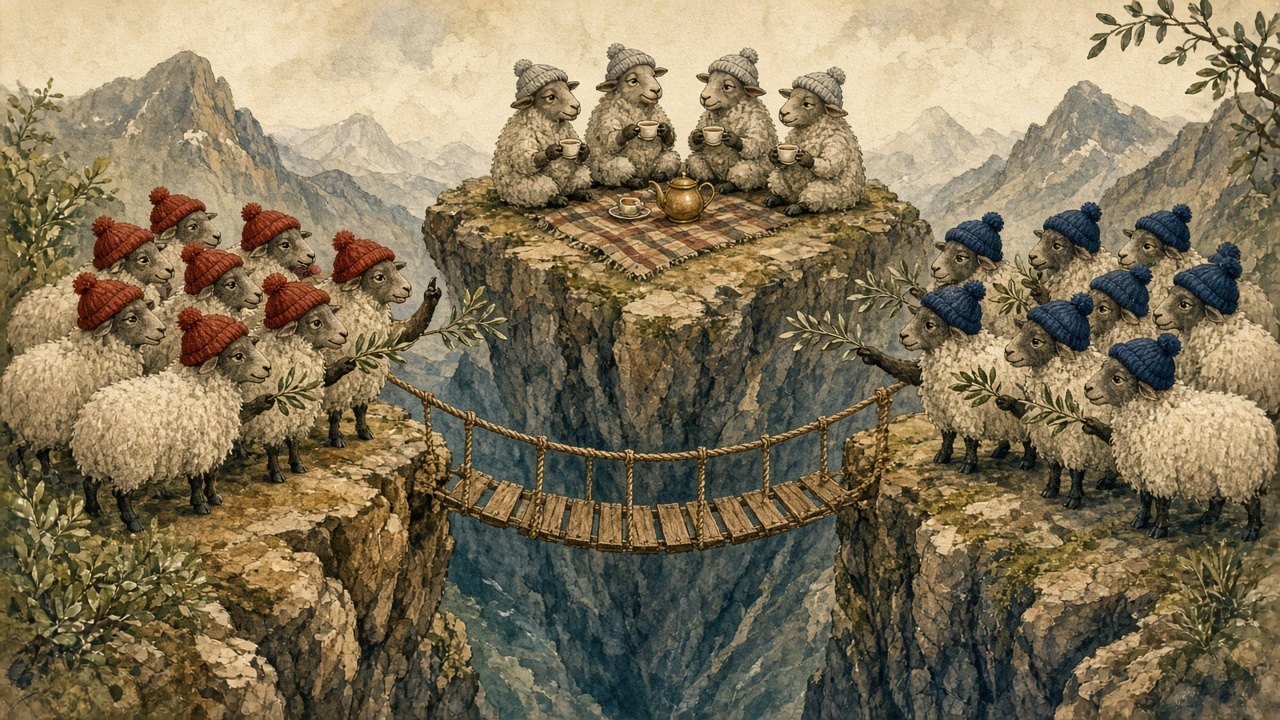
The Red tribe will tell you the Blues are sheep who believe whatever their media says. The Blue tribe will tell you the Reds are sheep who believe whatever their media says. The two media differ by a channel number. Each tribe has built a home-entertainment system whose only job is to show that the other tribe is stupid, and tuning in nightly to feel smart is the last bipartisan activity left in America.
One party says the other wants to control your life. The other party says the first one wants to control your life. Both are telling the truth about the wanting. Each just needs you scared of the other one, and then they need $25. You think you’re choosing between heads and tails. The coin belongs to the people selling the coin.
Graduation
You’re ready. You will go out into the world and think exactly what you were going to think anyway, and you’ll feel great about it. You will call it independence. Your tribe will call it loyalty. The people who run your tribe will call it a list, and they’ll sell it.
One last thing, and then we’ll let you go back to agreeing. Every manipulator who has ever played you started with the same compliment: you’re one of the smart ones. Everyone else is the herd. That line works on you, and on the people you can’t stand, and on us. The only person it doesn’t work on is someone more interested in being right than in feeling smart. We’ve checked. There aren’t many. We’d love to be wrong about that.
Satire This guide is a work of comedy and the first entry in National Sarcastic’s own series, For Really Stupid People. It is not affiliated with any real book series. The Desk of Persuasion is fictional. The Red and Blue tribes are both real, and both of them are you. National Sarcastic is not affiliated with National Geographic.